

Key Takeaway
*Balance exercises are a simple but valuable part of a complete fitness routine. Single-leg stands, heel-to-toe walks, single-leg Romanian deadlifts, standing knee raises, and side leg raises can help beginners develop stability, coordination, and body control.
*Start with movements that you can perform safely and use a stable support whenever necessary. As your control improves, gradually increase the challenge rather than rushing into advanced variations.
*For the best overall results, combine balance training with strength exercises, flexibility work, and regular physical activity. This approach can help create a more complete and sustainable Fitness & Exercise routine.
Introduction
Balance is an important part of physical fitness that is often overlooked. Good balance helps you control your body while standing, walking, changing direction, climbing stairs, and performing everyday activities. It also allows you to move with greater confidence and coordination.
Balance exercises are not only useful for athletes or older adults. Beginners can also benefit from simple balance training because it develops body awareness, stability, and control. These exercises can be performed at home with little or no equipment and can easily be added to a regular fitness routine.
Balance is influenced by several systems in the body, including muscles, joints, vision, and the nervous system. Improving it takes consistent practice rather than complicated workouts. The goal is to gradually improve your ability to control your body while maintaining a safe and comfortable position.
If you are new to exercise, you can first read our guide on [6 Best Exercises for Beginners to Improve Strength and Fitness], which provides a foundation of basic movements before adding more balance-focused exercises.
Why Are Balance Exercises Important?
Balance allows your body to maintain control while you are stationary or moving. It depends on coordination between your muscles, joints, nervous system, and sensory information from your surroundings.
Regular balance training can improve stability and movement control. It may also help you feel more confident during activities that require standing on one leg, changing direction, or controlling your body through different positions.
Balance should not be treated as a separate skill from strength and mobility. Strong muscles and adequate joint mobility provide an important foundation for maintaining good control during movement. This is why balance training works well when combined with strength, flexibility, and regular physical activity.
1. Single-Leg Stand

The single-leg stand is one of the simplest balance exercises for beginners. It challenges the muscles around your ankles, legs, hips, and core while requiring your nervous system to continuously make small adjustments to keep your body stable.
To perform the exercise, stand upright near a wall, countertop, or sturdy chair that you can use for support if necessary. Keep your posture tall and shift your weight gradually onto one leg. Lift the opposite foot slightly from the floor and try to maintain your position while looking straight ahead.
Keep your standing knee slightly relaxed rather than locking it completely. Your goal is to maintain control rather than remain perfectly motionless. Start with a short duration and gradually increase the time as your balance improves. Repeat on both sides because balance can naturally differ between your left and right legs.
For beginners, safety is more important than duration. Perform this exercise near a stable support and avoid standing on an unstable surface until you have developed adequate control.
2. Heel-to-Toe Walk

Heel-to-toe walking is a simple movement that challenges balance while you are actually moving. It can help develop coordination and control because the base of support becomes narrower than during normal walking.
Stand upright and look forward. Take a slow step forward by placing the heel of one foot directly in front of the toes of the opposite foot. Continue taking controlled steps while maintaining an upright posture.
Move slowly rather than trying to cover a long distance quickly. If you feel unstable, perform the exercise next to a wall or another secure surface. As your control improves, you can gradually increase the number of steps.
This exercise is particularly useful because it connects balance training with a movement pattern that resembles normal walking.
3. Single-Leg Romanian Deadlift

The single-leg Romanian deadlift is a more challenging balance exercise that combines stability, hip movement, and lower-body strength. It primarily involves the glutes and hamstrings while requiring significant control from the standing leg and core.
Begin by standing upright with your feet comfortably apart. Shift your weight onto one leg and keep a slight bend in the standing knee. Slowly move your other leg backward while your upper body moves forward from the hips.
Your body should form a relatively straight line from your extended leg through your torso. You do not need to lower yourself deeply. Move only as far as you can while maintaining control, then use your standing leg and hip muscles to return to an upright position.
This exercise requires more coordination than a basic single-leg stand, so beginners should first develop sufficient balance before attempting the full movement. Holding onto a stable surface can make the exercise more accessible while you learn the technique.
4. Standing Knee Raises
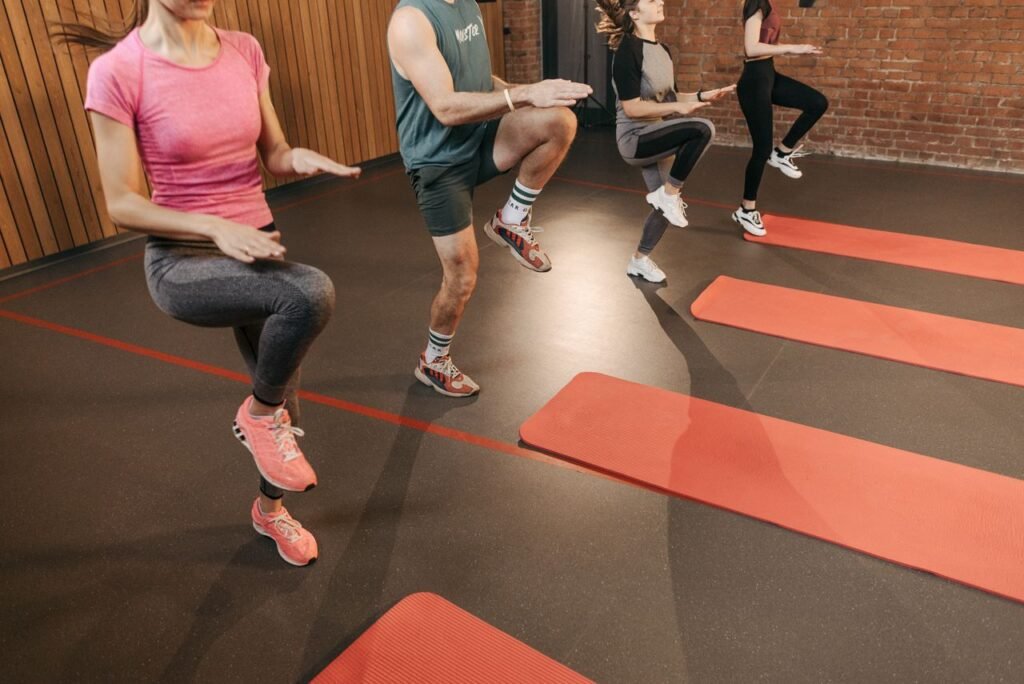
Standing knee raises are a simple way to combine balance, hip control, and core stability. The exercise requires you to maintain control on one leg while the opposite leg moves.
Stand tall with your feet about hip-width apart. Slowly lift one knee toward your comfortable range while keeping your standing leg stable. Pause briefly and then lower the raised leg under control before switching sides.
Avoid leaning backward or swinging the leg upward. The movement should remain slow and controlled, with your torso staying as upright as possible.
As your balance improves, you can increase the duration of the pause or perform the movement more slowly. Beginners should stay close to a wall or sturdy support if they feel unsteady.
5. Side Leg Raises
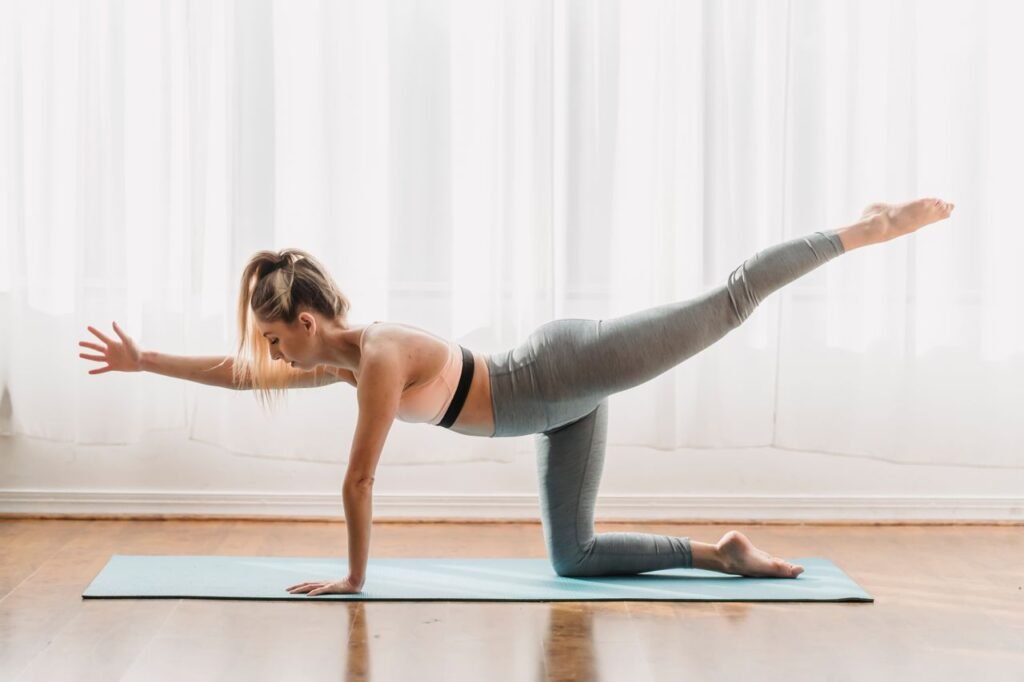
Side leg raises are a beginner-friendly stability exercise that targets the muscles around the hips while also challenging your ability to maintain a stable standing position.
Stand upright next to a wall or sturdy chair. Shift your weight onto one leg and slowly move the other leg outward to the side. Keep your toes generally facing forward and avoid rotating your entire body as the leg moves.
Pause briefly at the comfortable end of the movement and then slowly return the leg to the starting position. Repeat on both sides.
The movement does not need to be large. A controlled range of motion is more important than lifting the leg as high as possible. Over time, stronger hip muscles can contribute to better control during walking and other lower-body movements.
Read Related Articles–
1)Leg exercises for stronger legs
2) Walking for Weight Loss: How Much Should You Walk Every Day?
How Often Should You Do Balance Exercises?
Balance training does not require long workouts. Beginners can include a few balance exercises several times per week as part of their normal fitness routine.
Consistency is more important than trying to perform difficult variations immediately. Start with exercises that you can control safely and gradually increase the challenge as your stability improves.
Balance exercises can also be combined with strength training. For example, your existing [5 Best Leg Exercises for Stronger Legs and Better Lower-Body Fitness] article can complement this routine because stronger lower-body muscles provide an important foundation for controlled movement.
How to Improve Balance Safely
The most important principle of balance training is to create an environment where you can practice safely. Perform exercises on a stable, non-slip surface and keep a sturdy support nearby when necessary.
Start with both feet on the floor before progressing to exercises that require single-leg balance. Avoid closing your eyes or standing on unstable surfaces simply to make an exercise harder unless you have appropriate supervision and experience.
Progress should be gradual. You can increase the duration, reduce your reliance on support, or introduce a slightly more challenging movement once the basic version becomes comfortable.
Balance, Strength, and Flexibility Work Together
Balance is closely connected with other areas of fitness. Strength allows your muscles to produce and control force, while flexibility and mobility allow your joints to move through an appropriate range.
For this reason, a balanced fitness program should not focus exclusively on one type of exercise. Your [5 Best Flexibility Exercises for Beginners to Improve Mobility] article can complement this balance routine by addressing movement and range of motion.
Regular walking is another useful component of an active lifestyle. You can also link this article naturally to [Walking for Weight Loss: How Much Should You Walk Every Day?], particularly when discussing the importance of staying physically active throughout the day.
Common Mistakes to Avoid
One common mistake is trying to progress too quickly. Balance can be challenging even when an exercise looks simple, so increasing difficulty before developing adequate control can make the movement less safe.
Another mistake is relying heavily on momentum. Balance exercises should generally be performed slowly enough that you can control your body throughout the movement.
It is also important not to compare your balance ability with another person’s. Factors such as age, previous activity, strength, mobility, footwear, and individual anatomy can influence performance.
Most importantly, do not continue an exercise if you experience pain, dizziness, or unusual symptoms. Balance training should challenge your control without creating unnecessary risk.
Sources
1.Centers for Disease Control and Prevention (CDC) – Physical Activity Basics
2.U.S. Department of Health & Human Services – Physical Activity Guidelines
3.American College of Sports Medicine (ACSM)
4. Mayo Clinic – Fitness and Exercise 5.American Council on Exercise (ACE) – Exercise Library