

Key Takeaways
- Strength training can help improve muscular strength and physical function.
- Beginners can start with bodyweight exercises at home.
- Training all major muscle groups is important for balanced development.
- Consistency and proper technique matter more than starting with heavy weights.
- Adults are generally advised to perform muscle-strengthening activities at least twice per week.[1]
- Adequate recovery, balanced nutrition, and gradual progression support long-term progress.
- Exercises should be adapted to individual ability, health, and physical limitations.
Starting a fitness routine can feel overwhelming when you are unfamiliar with exercise techniques, workout schedules, or gym equipment. However, building strength does not necessarily require an expensive gym membership or complicated training program. Strength training for beginners can start with simple bodyweight exercises that help you develop strength, movement control, and confidence at your own pace. The key is to begin with manageable movements, learn the correct technique, and increase the difficulty gradually as your fitness improves.
Strength training, also called resistance training, involves working your muscles against resistance. This resistance can come from your own body weight, dumbbells, resistance bands, or gym equipment. Regular resistance exercise can help improve muscular strength and physical function. It is also an important component of a balanced fitness routine, alongside aerobic activities such as walking and cycling. According to the U.S. Department of Health and Human Services, adults should perform muscle-strengthening activities involving all major muscle groups on at least two days per week.[1]
Whether you want to make everyday activities easier, improve your physical fitness, or establish a sustainable workout habit, starting with the basics can help you build a strong foundation.
What Is Strength Training?
Strength training is a type of physical activity that challenges your muscles to produce force against resistance. When you perform a squat, push-up, or resistance-band exercise, your muscles work to control the movement and overcome the resistance. With consistent training and adequate recovery, your body can adapt to these demands and gradually become stronger.
Unlike aerobic exercise, which primarily challenges your cardiovascular system over sustained periods, strength training focuses on muscular strength, endurance, and function. The two forms of exercise complement each other. For example, walking can help improve aerobic fitness, while resistance exercises can strengthen the muscles used during everyday activities.
You do not need to lift heavy weights to begin strength training. Beginners can start with movements such as chair squats, wall push-ups, and glute bridges. As these exercises become easier, the challenge can be increased by performing additional repetitions, using resistance bands, adding weights, or progressing to more demanding variations.


What Are the Benefits of Strength Training for Beginners?
1. Helps Build Muscular Strength
One of the main benefits of strength training is improved ability to produce force. This can help with everyday activities such as carrying groceries, lifting objects, standing up from a chair, and climbing stairs. Beginners can develop strength through relatively simple exercises when they perform them consistently and gradually increase the challenge.
Strength gains depend on several factors, including training frequency, exercise selection, technique, recovery, and individual characteristics. You do not need to train until complete exhaustion to make progress. A manageable routine that you can maintain consistently is a practical starting point.
2. Supports Everyday Physical Function
Muscular strength contributes to the movements you perform throughout the day. Exercises that train the legs, hips, chest, back, shoulders, and core can help develop the physical capacity required for daily tasks.
For example, squats train movements associated with sitting and standing, while pushing exercises strengthen muscles involved in pushing objects. A balanced program should therefore include a variety of movements rather than focusing exclusively on one muscle group.
3. Supports Bone and Muscle Health
Resistance exercise places mechanical demands on muscles and the skeletal system. Over time, appropriate training can support muscle development and may contribute to maintaining bone health. However, the effects depend on the exercise program, the individual’s health, and other lifestyle factors.
Strength training can be particularly valuable as part of a long-term approach to physical health, but people with osteoporosis, previous fractures, or other medical conditions may need individualized guidance about appropriate exercises and resistance levels.
4. Complements Cardiovascular Exercise
Strength training and aerobic activity serve different but complementary purposes. Walking, cycling, and swimming can help improve cardiovascular fitness, while resistance exercises develop muscular strength and function.
Combining these activities can create a more balanced fitness routine. If you already walk regularly, adding two manageable strength sessions per week may be a practical way to expand your exercise program.
5 Best Strength Training Exercises for Beginners
The following exercises provide a practical starting point for people who want to develop strength at home. Choose variations that match your current ability, and focus on controlled movement rather than trying to complete as many repetitions as possible.
1. Bodyweight Squats

Bodyweight squats are a foundational lower-body exercise that primarily works the quadriceps and glutes while also involving other muscles that help stabilize your body. The movement resembles sitting down and standing up, making it relevant to everyday activities.
Stand with your feet approximately shoulder-width apart. Keep your chest comfortably upright and your core gently engaged. Bend your knees and move your hips backward as if sitting into a chair. Lower yourself only as far as you can comfortably maintain control, then push through your feet to return to standing.
Beginners who find standard squats difficult can start by sitting down on a sturdy chair and standing up again. This variation provides a familiar movement pattern and allows you to adjust the range of motion. As your strength improves, you can gradually progress to unsupported squats or add resistance.
2. Wall Push-Ups

Wall push-ups train the chest, shoulders, and triceps while allowing you to adjust the difficulty by changing your body position. Because your hands remain against a wall, this variation is often more accessible than a traditional floor push-up.
Stand facing a wall and place your palms against it at approximately chest height. Position your feet a comfortable distance away from the wall. Bend your elbows slowly to bring your chest toward the wall, keeping your body aligned from head to heels. Push through your hands to return to the starting position.
Avoid arching your lower back or moving your head forward excessively. The movement should remain controlled throughout each repetition. Once wall push-ups become comfortable, you may progress to push-ups against a stable countertop or another appropriately elevated surface.
3. Glute Bridges
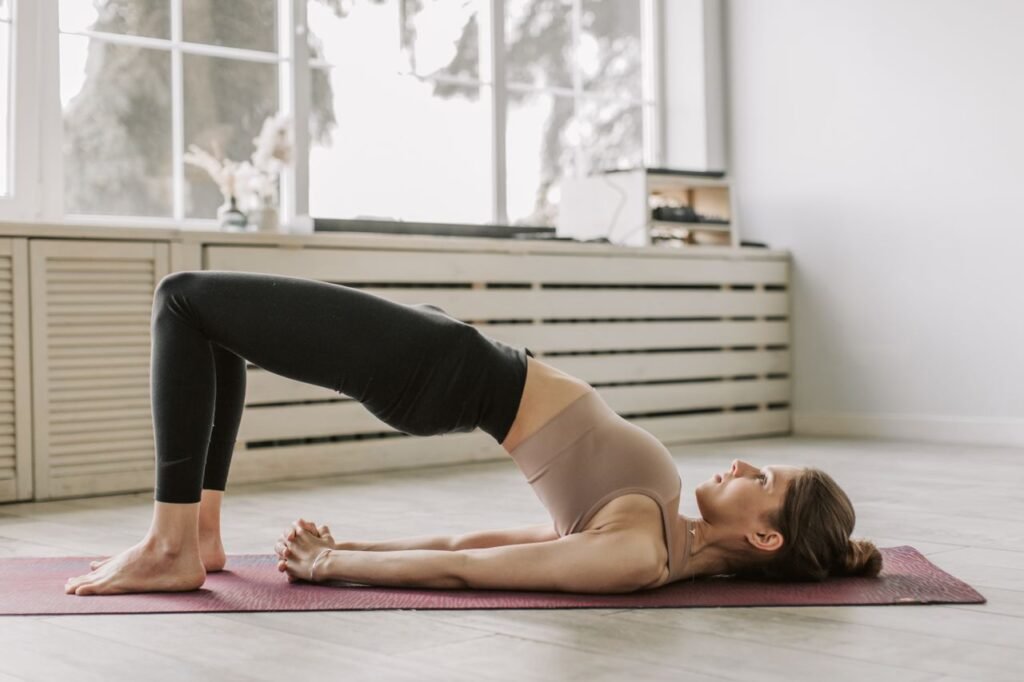
Glute bridges primarily target the gluteal muscles and also involve the hamstrings. These muscles contribute to hip movement and lower-body stability, making glute bridges a useful addition to a beginner strength program.
Lie on your back with your knees bent and your feet flat on the floor. Keep your arms resting beside your body. Gently engage your abdominal muscles and squeeze your glutes as you lift your hips. Pause briefly at the top without excessively arching your lower back, then lower your hips slowly.
The goal is to use your hip muscles rather than force your body into an unnecessarily high position. If you experience discomfort, reduce the range of motion or stop the exercise. As your strength improves, you can gradually increase repetitions or explore more challenging variations.
4. Bird Dog

The bird dog is a bodyweight exercise that challenges core stability and coordination. It involves extending the opposite arm and leg while maintaining control of the trunk, making it useful for practicing coordinated movement.
Begin on your hands and knees, with your hands underneath your shoulders and your knees underneath your hips. Gently engage your core and extend one arm forward while extending the opposite leg backward. Keep your torso as stable as possible rather than allowing your hips to rotate. Return to the starting position and repeat on the opposite side.
Start with a small range of motion if maintaining balance is difficult. You can also begin by moving only one arm or one leg at a time. Focus on slow, controlled repetitions instead of lifting your limbs as high as possible.
5. Standing Calf Raises

Standing calf raises strengthen the calf muscles, which contribute to movements such as walking, running, and rising onto the balls of your feet. This exercise is simple to perform and requires no specialized equipment.
Stand upright with your feet comfortably apart. Hold a wall or sturdy chair for balance if needed. Slowly raise your heels until you are standing on the balls of your feet. Pause briefly, then lower your heels under control.
Avoid bouncing or rushing through the movement. Beginners can start with both feet on the floor and gradually increase repetitions as the exercise becomes easier. People who have difficulty maintaining balance should use a secure support and avoid performing the exercise on an unstable surface.
How Often Should Beginners Do Strength Training?
For most healthy adults, a practical starting point is to perform strength training on two nonconsecutive days per week, allowing recovery time between sessions. General U.S. physical activity guidelines recommend muscle-strengthening activities involving all major muscle groups on at least two days per week.[1]
Your initial routine does not need to be long or complicated. You might begin with one set of each exercise, using a number of repetitions that allows you to maintain proper technique. As your fitness improves, you can gradually add another set or increase the resistance.
Recovery is an important part of the process. Muscles need time to adapt to training, and exercising the same muscles intensely every day is not necessary for beginners. If an exercise causes persistent pain or unusual symptoms, stop and reassess it rather than attempting to push through the discomfort.
How to Create a Simple Beginner Strength Routine
A useful beginner program should cover different movement patterns and major muscle groups. The five exercises in this article provide a starting point, but they do not cover every muscle group equally. As your experience increases, consider adding appropriate pulling exercises, such as resistance-band rows, to train the back.
You can organize your first few weeks around two manageable sessions per week. Begin with a brief warm-up, such as easy marching in place or comfortable walking. Then perform your chosen strength exercises with controlled movements and sufficient rest between sets. Finish with a few minutes of gentle movement.
You should be able to complete each exercise without sacrificing technique. If the final repetitions become difficult enough that you cannot maintain control, reduce the number of repetitions or choose an easier variation. Progress gradually rather than increasing every aspect of your workout at once.
Common Strength Training Mistakes to Avoid
Using Poor Technique
Trying to complete more repetitions than you can control may reduce the quality of your training and increase the risk of discomfort or injury. Learn the movement first and increase the difficulty only when you can perform it comfortably.
Progressing Too Quickly
Beginners sometimes increase repetitions, resistance, and workout frequency at the same time. This can make it harder to recover and maintain consistency. Change one aspect of your routine gradually and monitor how your body responds.
Training Only One Muscle Group
Focusing exclusively on the arms, legs, or abdominal muscles can leave other areas undertrained. A balanced program should address the major muscle groups over the course of the week.
Ignoring Recovery
Exercise is only one part of a training program. Sleep, nutrition, hydration, and recovery between demanding sessions also contribute to your ability to maintain a consistent routine.
How Nutrition Supports Strength Training
Your body needs adequate energy and nutrients to support regular exercise. A balanced eating pattern can include vegetables, fruit, whole grains, protein-rich foods, and sources of healthy fats. The appropriate amount of food varies according to factors such as age, body size, activity level, health, and personal goals.
Protein contributes to the maintenance and growth of muscle tissue, but supplements are not automatically necessary for beginners. Many people can obtain protein from foods such as beans, lentils, dairy products, eggs, fish, poultry, tofu, and other suitable sources.
Avoid assuming that a more restrictive diet or an excessive amount of exercise will produce better results. If you have a medical condition that affects nutrition or exercise tolerance, a qualified healthcare professional or registered dietitian can help you determine an appropriate approach.
Frequently Asked Questions
Is strength training suitable for beginners?
Strength training can be suitable for many beginners when exercises are adapted to their ability and performed with appropriate technique. People with medical conditions, injuries, or significant physical limitations may need professional guidance before starting.
Can I do strength training at home without equipment?
Yes. Bodyweight exercises such as squats, wall push-ups, glute bridges, and bird dogs can provide a starting point. As you become stronger, resistance bands or weights may help you increase the challenge.
How long does it take to see results from strength training?
Progress varies according to training consistency, exercise difficulty, nutrition, recovery, and individual characteristics. Some people notice improvements in movement control or exercise tolerance before seeing visible changes in muscle size. There is no single timeline that applies to everyone.
Should beginners lift heavy weights?
Beginners do not need to start with heavy weights. Learning proper technique and selecting a manageable resistance are more important initially. Resistance can be increased gradually as strength and control improve.
Is strength training enough for overall fitness?
Strength training is an important component of fitness, but it does not replace all forms of physical activity. A balanced routine should also include aerobic exercise and regular movement throughout the day.
Sources
1. U.S. Department of Health and Human Services — Physical Activity Guidelines for Americans. Provides recommendations for aerobic activity and muscle-strengthening activities for adults.
2. Centers for Disease Control and Prevention (CDC) — Physical Activity Basic. Provides general information about physical activity and its role in health.
3. American College of Sports Medicine (ACSM). Provides professional resources and educational material related to exercise science and physical activity.
4. American Council on Exercise (ACE) — Exercise Library. Provides exercise instructions and information about movement technique.
5. Mayo Clinic — Fitness and Exercise. Provides general educational resources on exercise, fitness, and healthy activity habits.
6. National Institute on Aging — Exercise and Physical Activity. Provides information about physical activity, strength, balance, and exercise considerations, particularly for older adults.
7. National Health Service (NHS) — Exercise. Provides public-health guidance and practical information about exercise and physical activity.
Disclaimer
This article is for general educational purposes only and is not a substitute for professional medical advice, diagnosis, or treatment. Consult a qualified healthcare professional before starting a new exercise program if you have a medical condition, injury, or physical limitation. Stop exercising if you experience unusual pain, dizziness, chest discomfort, or other concerning symptoms.