
Key Takeaways
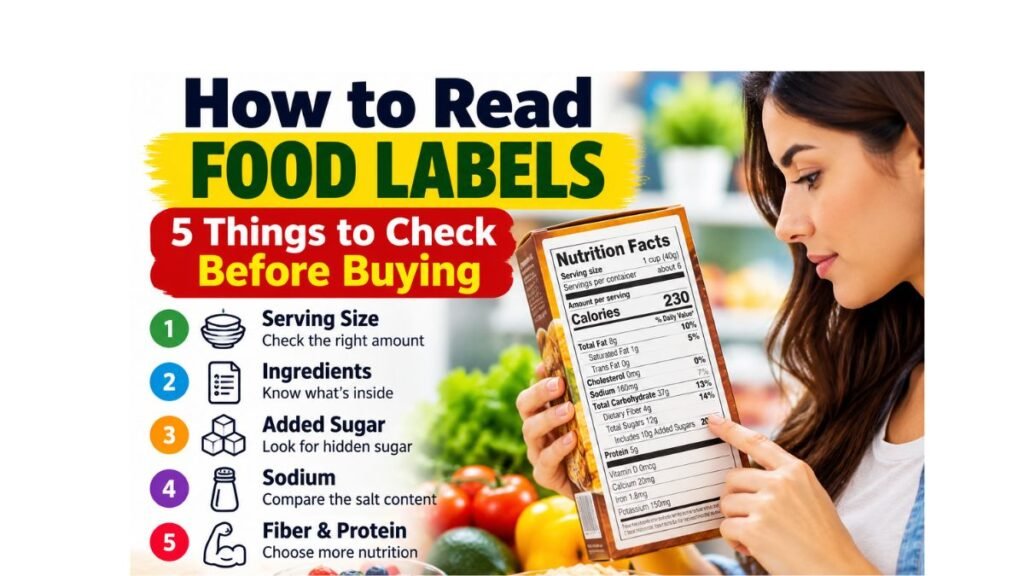
- Learning how to read food labels can help you compare packaged foods and make informed choices.
- Serving size matters because the nutrition information on a package may refer to less food than you actually eat.
- Ingredient lists can help you understand what a product contains and identify ingredients you want to limit.
- Added sugar, sodium, fiber, protein, and saturated fat are useful details to consider when comparing similar products.
- No single number or ingredient determines whether a food is healthy; the overall nutritional profile and your usual eating habits matter.
Have you ever picked up two similar packaged foods and wondered which one is the healthier choice? Their packaging may look almost identical, yet their nutritional content can differ considerably. One breakfast cereal may contain more fiber, while another contains more added sugar. Two packaged snacks may have similar calorie counts but very different amounts of sodium, protein, or saturated fat. Without understanding the information on the package, it can be difficult to know what these differences mean. Learning how to read food labels gives you a practical way to make sense of this information. You do not need to memorize every nutrient or spend several minutes examining every product in a supermarket. Instead, you can develop a simple routine: check the serving size, review the ingredients, compare important nutrients, understand the sugar information, and consider the product as a whole. These habits can help you make more informed food choices[1][2] without following unnecessarily restrictive rules or assuming that expensive products are automatically healthier.
What Is a Food Nutrition Label?
A food nutrition label provides information about a packaged product, including its ingredients and, depending on the applicable labeling requirements, its energy and nutrient content. The exact format and mandatory information vary between countries, so labels in India may not look identical to those in the United States or the United Kingdom. In India, the Food Safety and Standards Authority of India (FSSAI) establishes food labeling and display requirements. These requirements help consumers access relevant information about packaged foods, although the specific information available can vary by product and applicable regulations. The purpose of a label is not to tell you that a product is automatically healthy or unhealthy. Instead, it provides details that you can use to compare products and decide how they fit into your eating pattern.
If you are also working on your overall diet, our article What Is a Healthy Diet? A Complete Guide to Balanced Nutrition can be a useful starting point for understanding healthy eating.
1. Check the Serving Size Before Looking at Calories
One of the most important steps in learning how to read food labels is understanding serving size. The calories and nutrient amounts shown on a nutrition label may refer to a particular serving rather than the entire package.[2] If you overlook this detail, you could misunderstand how much energy, sugar, sodium, or fat you are consuming. For example, imagine a packet of crackers contains two servings, and the label lists 150 calories per serving. If you eat the entire packet, you consume 300 calories, assuming the package contains exactly two servings. The same calculation applies to other nutrients listed per serving. If a serving contains 5 grams of sugar, eating two servings provides 10 grams of sugar. This does not mean that you must weigh every food or count every calorie. Serving information is simply a useful reference that helps you interpret the numbers correctly. It can be particularly helpful with packaged snacks, sweetened beverages, breakfast cereals, and foods that are easy to consume in larger quantities than intended.
How to Use Serving Size in Everyday Shopping
When comparing two products, check whether their nutrition information is based on comparable serving sizes. One product may appear lower in calories because its listed serving is smaller, rather than because its nutritional composition is substantially different. Also remember that a serving size printed on a package is not necessarily a recommendation for how much you should eat. Your appropriate portion depends on factors such as your nutritional needs, appetite, activity level, and the rest of your meals.
Practical tip: Before comparing calorie or sugar numbers, look at the serving size and the number of servings in the package. This simple habit makes the rest of the label easier to understand.
2. Read the Ingredient List, Not Just the Front of the Package
Food packaging often uses phrases such as natural, multigrain, light, or made with whole grains. These descriptions may provide some information, but they do not tell you everything about a product’s nutritional quality. The ingredient list gives you a more detailed picture of what the food contains. Ingredients are generally listed in descending order by weight under many food labeling systems. This means ingredients appearing near the beginning typically contribute more to the product by weight than ingredients listed later. However, the exact interpretation depends on the product and applicable labeling rules. For example, if you are choosing a breakfast cereal, you may want to see whether whole grains are prominent in the ingredient list and whether the product contains added sweeteners. If you are buying a packaged snack, you might compare its ingredients, fiber content, sodium, and saturated fat with those of similar products. Neither a long ingredient list nor an unfamiliar ingredient automatically makes a food unhealthy; the important consideration is what the ingredients are and how the product fits into your overall diet.
Which Ingredients Should You Look For?
Depending on the product, you may want to identify:
- Whole grains: Ingredients such as whole-wheat flour or oats may help you identify products made with whole grains.
- Added sweeteners: Sugar, syrups, and other sweetening ingredients can contribute to added sugar.
- Sources of protein: Milk ingredients, soy, legumes, nuts, seeds, eggs, or other protein-containing ingredients may be relevant.
- Allergens: Ingredients such as milk, peanuts, soy, wheat, or other regulated allergens matter if you have an allergy or need to avoid a specific ingredient.
In India, packaged foods may also provide allergen declarations and other information required under applicable rules. Read the complete label when you need to avoid a particular ingredient, and do not rely only on the product’s front packaging.
Practical tip: Compare similar products rather than assuming that a particular ingredient automatically makes a food good or bad. A useful choice depends on the complete ingredient list and nutritional information.
3. Compare Added Sugar, Sodium, and Saturated Fat
When learning how to read nutrition labels, it helps to focus on a few nutrients that are especially useful for comparing similar packaged products. Added sugar, sodium, and saturated fat are three examples. You do not need to eliminate these nutrients completely. Your body needs a range of nutrients, and the amount that makes sense depends on your overall dietary pattern and individual needs. However, regularly consuming large amounts of certain nutrients, particularly when they displace more nutritious foods, may make it harder to maintain a healthy eating pattern.
Added Sugar: Look Beyond Sweet-Tasting Foods
Added sugar can appear in sweetened drinks, confectionery, desserts, some breakfast cereals, flavored dairy products, and other packaged foods. Products that do not taste particularly sweet may also contain added sugar. Check the information available on the package and compare similar products when possible. Depending on the country and product, the label may distinguish total sugars from added sugars or provide sugar information in another format. Whole fruits contain naturally occurring sugars along with water, fiber, and other nutrients. Plain milk also contains naturally occurring lactose. These foods are different from products to which sugar has been added, so it is important not to treat all sources of sugar as nutritionally identical.
For more information about this distinction, read our article How Much Added Sugar Should You Eat a Day? 5 Simple Ways to Cut Back.
Sodium: Pay Attention to Salt Content
Sodium is an essential mineral, but excessive sodium intake can contribute to high blood pressure in some people. Packaged soups, instant noodles, savory snacks, sauces, and seasoning mixes can contain substantial amounts of sodium, although the levels vary widely between products. When comparing two similar products, check their sodium content and consider how much you are likely to eat. A food with a moderate sodium level per serving can contribute more sodium if you consume several servings. Remember that sodium and salt are related but are not identical measurements. Sodium is one component of salt, and nutrition labels may display sodium or salt depending on the labeling system.
Saturated Fat: Consider the Overall Fat Profile
Some packaged foods contain significant amounts of saturated fat. Regularly consuming high amounts of saturated fat can raise LDL cholesterol in many people, although the overall dietary pattern and the foods replacing saturated fat also matter. Rather than avoiding all fat, compare similar products and consider the amounts of saturated and unsaturated fats. Nuts, seeds, and certain plant oils provide unsaturated fats, while butter and some high-fat animal products contain more saturated fat.
Practical tip: Compare products within the same category. Choosing a cereal with less added sugar, a snack with less sodium, or a product with a more suitable fat profile can be a practical improvement without requiring you to change your entire diet.
4. Look at Fiber, Protein, and Other Useful Nutrients
Calories are only one part of a food’s nutritional value. Two products with similar calorie counts can provide different amounts of protein, fiber, vitamins, and minerals. This is why understanding how to read food labels involves looking beyond energy alone. Protein helps maintain and repair body tissues and supports many normal functions. Fiber, found in foods such as whole grains, legumes, vegetables, fruits, nuts, and seeds, supports digestive health and can help meals feel more satisfying. Many people can benefit from including a variety of foods that provide these nutrients.
Why Fiber Is Worth Checking
When comparing breakfast cereals, breads, crackers, or other grain-based products, fiber content can be a useful consideration. Whole-grain products often provide more fiber than comparable refined-grain products, although the actual amount varies by product. Increasing fiber intake gradually is often more comfortable than making a sudden large change. Drinking adequate fluids and including a variety of fiber-containing foods can also help support digestive health. You can explore more food choices in our article 10 High-Fiber Foods to Add to Your Daily Diet for Better Health.
Protein Can Help You Compare Similar Foods
Protein information may be particularly useful when choosing yogurt, milk alternatives, snack products, breakfast foods, or ready-to-eat meals. However, a product containing more protein is not automatically the best choice. It is also worth checking its added sugar, sodium, saturated fat, and overall ingredients. For example, when comparing two snack products, one may provide more protein but also contain substantially more sodium. The better choice depends on your needs and the complete nutritional profile rather than one number alone.
Practical tip: Look at the nutrients that matter most for the food you are buying. Fiber may be particularly relevant when comparing cereals, while sodium may deserve more attention when comparing instant soups or savory snacks.
5. Compare Similar Products and Consider the Whole Picture
The final step is to bring the information together. A label becomes more useful when you compare two or three similar products rather than judging one food in isolation. For example, compare different breakfast cereals with each other, different breads with each other, or different packaged sauces within the same category. You might find that one product contains more fiber, another has less added sugar, and a third provides less sodium. There may not be one perfect product for every person. Instead, choose the option that best matches your nutritional priorities, preferences, budget, and dietary requirements.[2][4]
A Simple Food Label Comparison
| What to Check | Why It Matters | Practical Approach |
| Serving size | Helps interpret the listed nutrient amounts | Check how much you usually eat |
| Ingredients | Shows what the product contains | Read the complete list |
| Added sugar | Helps identify added sweeteners | Compare similar products |
| Sodium | Helps you assess salt-related intake | Compare savory packaged foods |
| Saturated fat | Helps you understand the fat profile | Compare similar products |
| Fiber and protein | Provides information about useful nutrients | Consider the product’s overall nutritional value |
It is also important to remember that packaged foods are not automatically unhealthy. Frozen vegetables, canned beans, plain yogurt, whole-grain bread, and many other packaged products can fit into a nutritious diet. Some foods may be fortified with vitamins or minerals, and certain packaged options can be affordable and convenient. Likewise, a food marketed as organic, natural, multigrain, or high protein should not be judged by that phrase alone. Review the available nutritional information and ingredients to understand what you are actually buying.


Make Food Label Reading a Simple Habit
You do not need to examine every line on every package every time you shop. Start by checking the serving size, ingredients, and two or three nutrients that are most relevant to your choice. With practice, you can make comparisons more quickly. If you have diabetes, high blood pressure, kidney disease, food allergies, or another condition that affects your dietary needs, your priorities may be different. A qualified healthcare professional or registered dietitian can help you understand which label information is most relevant to your situation.
Final Thoughts
Learning how to read food labels can make everyday food shopping easier and help you make informed decisions without relying entirely on marketing claims. By checking serving sizes, reading ingredients, comparing added sugar and sodium, looking at fiber and protein, and evaluating similar products side by side, you can develop a practical approach to choosing packaged foods. You do not need to find a perfect product or avoid every food that contains sugar, fat, or sodium. Instead, use the label as one source of information and consider how each food fits into your overall diet. Small, realistic decisions made consistently can help you build a more nutritious and sustainable eating pattern.
Sources
1. Food Safety and Standards Authority of India (FSSAI)
Official Indian food safety authority, including regulations and consumer information.
2. U.S. Food and Drug Administration (FDA) — How to Understand and Use the Nutrition Facts Label
Explains serving sizes, calories, and nutrients on the U.S. Nutrition Facts label.
3. U.S. Food and Drug Administration (FDA) — Added Sugars on the Nutrition Facts Label
Explains how added sugars are displayed on U.S. food labels.
4. World Health Organization (WHO) — Healthy Diet
Provides general guidance on healthy dietary patterns and limiting certain nutrients.
5. National Institutes of Health (NIH), MedlinePlus — Reading Food Labels.Consumer-oriented health information and guidance.
6. U.S. Department of Agriculture (USDA) — Dietary Guidelines for Americans. General dietary guidance on nutrient-rich food choices and healthy eating patterns.
Disclaimer
This article is for general educational purposes only and is not a substitute for personalized medical or nutritional advice. If you have a medical condition, food allergy, or specific dietary requirement, consult a qualified healthcare professional or registered dietitian.