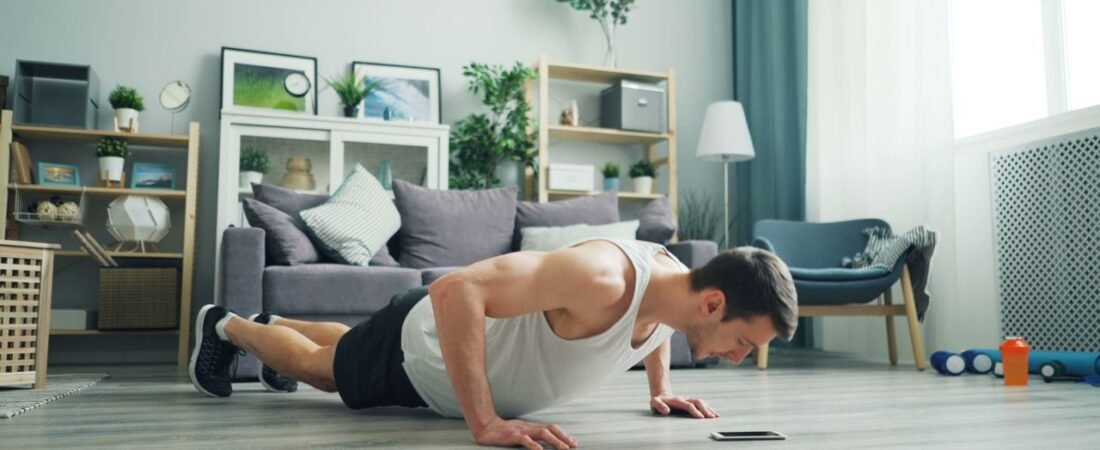
Exercises to improve fitness at home can help beginners build strength, improve mobility, and support overall health without needing expensive gym equipment. Staying physically active does not always require a gym membership, expensive equipment, or a complicated workout program. With a small amount of space and a few simple movements, you can create an effective exercise routine at home. The right combination of exercises can help improve muscular strength, cardiovascular fitness, balance, mobility, and overall physical function.
For beginners, the most important part of starting a home workout is choosing exercises that are easy to understand and appropriate for your current fitness level. Bodyweight movements are particularly useful because they allow you to learn fundamental movement patterns before adding resistance or increasing workout intensity.
The goal should not be to complete the hardest workout possible. Instead, focus on performing each movement with good technique, exercising consistently, and gradually increasing the challenge as your body becomes stronger and more comfortable with regular physical activity.
Why Exercise at Home Can Improve Your Fitness
Home workouts can make physical activity easier to fit into a busy schedule. You can exercise without commuting to a gym, and many movements require little or no equipment. This convenience can make it easier to establish a consistent routine, which is more important for long-term fitness than occasional intense workouts.
A balanced routine should include different types of movement rather than focusing on only one muscle group. Strength exercises can help maintain and develop muscle, while aerobic movements can improve cardiovascular endurance. Mobility and balance exercises can also support better movement quality and everyday physical function.
The following exercises to improve fitness at home provide a practical starting point for beginners and can be modified as your fitness level develops.
1. Bodyweight Squats
Bodyweight squats are one of the most useful exercises for developing lower-body strength because they train the muscles involved in sitting, standing, and many everyday movements. Squats primarily work the thighs and hips while also requiring the core and other stabilizing muscles to help maintain balance and control.
To perform the movement, stand with your feet approximately shoulder-width apart. Keep your chest comfortably upright, engage your core gently, and push your hips backward as you bend your knees. Lower your body only as far as you can while maintaining good technique, then press through your feet to return to standing.
Beginners can start with 2–3 sets of 8–12 repetitions. If balance or mobility is challenging, practice sitting toward a sturdy chair and standing again. As the movement becomes easier, you can increase repetitions or eventually add resistance.
2. Wall Push-Ups
Push-ups are excellent for developing upper-body strength, but traditional floor push-ups can be difficult for beginners. Wall push-ups provide an easier variation while allowing you to practice the same basic pushing movement.
Stand facing a wall and place your hands against it at approximately chest height. Walk your feet slightly backward, keep your body relatively straight, and bend your elbows to bring your chest toward the wall. Push through your hands to return to the starting position.
Wall push-ups can gradually prepare your muscles for more challenging variations such as incline or floor push-ups. Begin with 2–3 sets of 8–15 repetitions, depending on your ability.
3. Reverse Lunges
Reverse lunges are useful for strengthening the legs while also challenging balance and coordination. Because each leg works independently, the exercise can help you develop control and stability in addition to lower-body strength.
Start standing with your feet comfortably apart. Step one foot backward and bend both knees to lower your body. Keep your front foot stable and your torso upright, then push through the front foot to return to the starting position. Repeat on the other side.
Beginners can hold onto a sturdy chair or wall for additional balance. Start with 6–10 repetitions per leg and gradually increase as your control improves.
4. Glute Bridges
Glute bridges are a simple floor-based exercise that focuses on the muscles around the hips and buttocks. They also require some core control and can help beginners become more familiar with controlled hip movement.
Lie on your back with your knees bent and feet flat on the floor. Keep your feet comfortably apart and your arms beside your body. Press through your feet and lift your hips until you reach a comfortable position, then pause briefly before slowly lowering your hips.
Start with 2–3 sets of 10–15 repetitions. The objective is controlled movement rather than lifting the hips as high as possible.
5. Marching in Place
Marching in place is one of the easiest ways for beginners to introduce more cardiovascular activity into a home workout. It requires very little space and can be adjusted easily according to your fitness level.
Stand upright and alternately lift your knees while moving your arms naturally. Start slowly and gradually increase your pace if you feel comfortable. A faster marching pace can raise your heart rate without requiring the impact associated with running or jumping.
Try 5–10 minutes of marching as part of a warm-up or as a low-impact cardiovascular exercise.
6. Plank
The plank is an isometric exercise that develops core stability by requiring the body to maintain a controlled position. A strong and stable core supports many other movements and can contribute to better control during exercise.
For a basic plank, place your forearms on the floor with your elbows approximately underneath your shoulders. Extend your legs behind you and support your body through your forearms and feet. Keep your body relatively straight and breathe normally while maintaining the position.
Beginners can start with 15–30 seconds for 2–3 sets. As your core endurance improves, gradually increase the duration.
7. Step-Ups
Step-ups are a practical lower-body exercise that can improve leg strength, balance, and coordination. They also imitate the everyday movement of climbing stairs.
Use a stable, low step or platform that cannot move while you exercise. Place one foot on the platform, push through that leg, and bring the other foot up. Step back down under control and repeat, alternating legs.
Start with 8–12 repetitions per side. The height of the step should be appropriate for your current ability rather than chosen simply to make the exercise harder.
8. Bird Dog
The bird dog is a controlled exercise that challenges core stability, balance, and coordination. Unlike some faster exercises, it encourages beginners to concentrate on maintaining control while moving the arms and legs.
Start on your hands and knees with your hands beneath your shoulders and knees beneath your hips. Slowly extend one arm and the opposite leg while keeping your torso stable. Hold briefly, return to the starting position, and repeat on the opposite side.
Perform 6–10 controlled repetitions per side.
9. Standing Calf Raises
Calf raises are a simple exercise for strengthening the muscles at the back of the lower legs. These muscles contribute to walking, climbing stairs, and other everyday movements.
Stand upright with your feet comfortably apart. Hold onto a wall or sturdy surface if necessary. Slowly raise your heels so that you are standing on the balls of your feet, pause briefly, and then lower your heels with control.
Start with 2–3 sets of 10–15 repetitions.
10. Low-Impact Jumping Jacks
Low-impact jumping jacks provide a beginner-friendly way to increase cardiovascular activity without requiring repeated jumping. Instead of jumping both feet outward, step one foot to the side while raising your arms and then return to the starting position.
Continue by alternating sides at a comfortable pace. As your fitness improves, you can gradually transition toward traditional jumping jacks if appropriate.
Try 20–30 seconds, followed by a short rest, and repeat for 2–3 rounds.
How to Make Your Home Workouts More Effective
Progress does not always mean exercising for longer periods. You can improve your workouts by gradually increasing repetitions, extending the duration of an exercise, reducing unnecessary rest, or moving to a more challenging variation.
Consistency should come before intensity. If your routine is so difficult that you cannot maintain it regularly, reducing the workload can actually help you make better long-term progress.
It is also useful to combine strength exercises with regular aerobic activity such as brisk walking, cycling, or other activities you enjoy. This creates a more balanced approach to overall fitness.
Safety Tips for Beginners
Start every workout with several minutes of easy movement to prepare your body. Use controlled technique and avoid forcing a joint into an uncomfortable position.
Mild muscle fatigue during exercise can be expected, but sharp or unusual pain should not be ignored. Stop the movement if something feels wrong and allow yourself to recover.
If you have an existing medical condition, significant injury, or concerns about beginning a new exercise program, speak with a qualified healthcare professional before starting.
Sources
Centers for Disease Control and Prevention (CDC) — Physical Activity Basics
https://www.cdc.gov/physical-activity-basics/
U.S. Department of Health and Human Services — Physical Activity Guidelines for Americans
https://health.gov/our-work/nutrition-physical-activity/physical-activity-guidelines
American College of Sports Medicine (ACSM) — Physical Activity Guidelines
https://www.acsm.org/education-resources/trending-topics-resources/physical-activity-guidelines
Mayo Clinic — Exercise and Fitness
https://www.mayoclinic.org/healthy-lifestyle/fitness
American Council on Exercise (ACE) — Exercise Library
https://www.acefitness.org/resources/everyone/exercise-library/